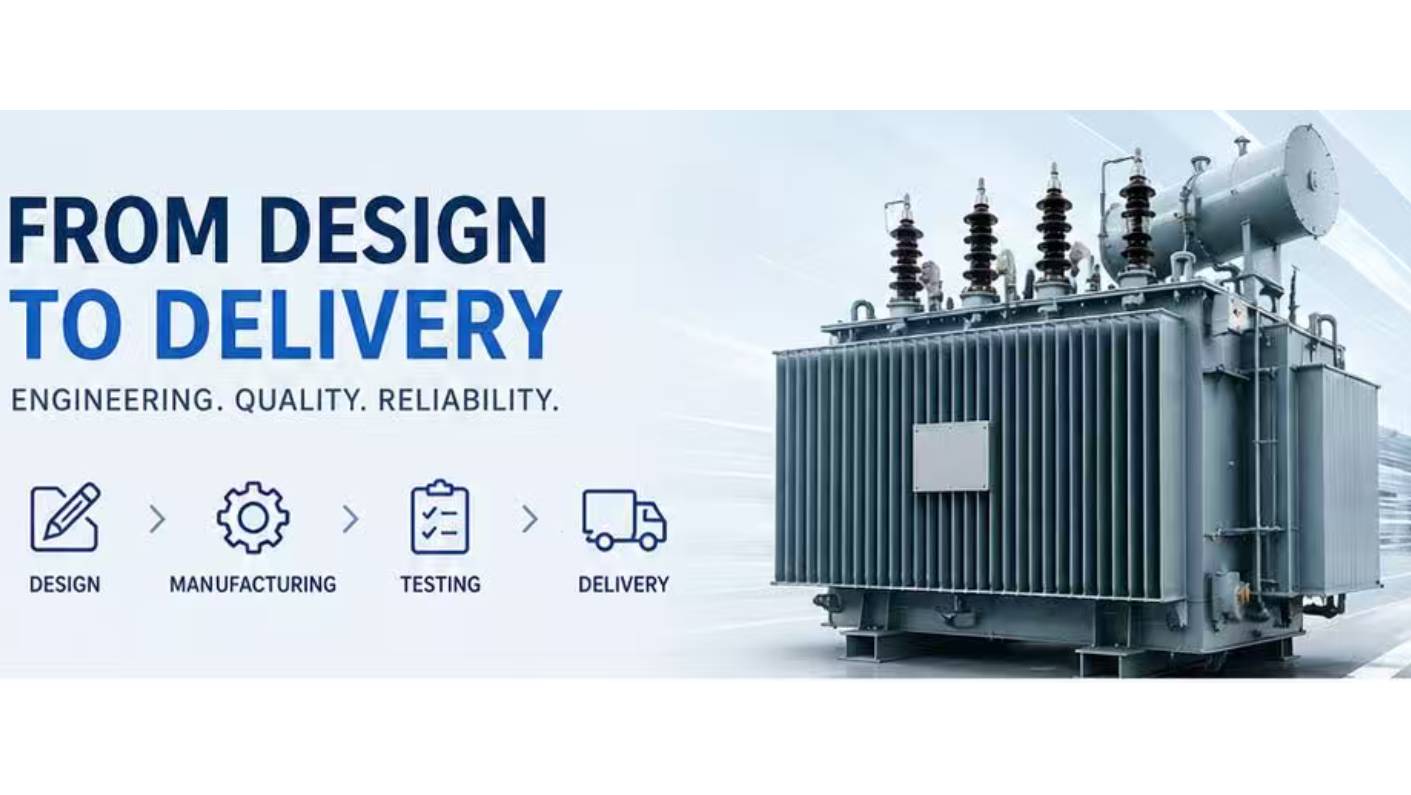
A transformer may look straightforward from the outside, but behind its steel enclosure is a carefully engineered electrical system that may be expected to operate reliably for decades.
For a professional transformer manufacturer, quality does not begin with the final inspection. It begins much earlier—with understanding the customer’s application, developing the right design, selecting suitable materials, controlling every manufacturing process, and verifying the finished product before shipment.
This is why we believe that a reliable transformer is not simply manufactured.
It is engineered, built, tested, and verified step by step.
1. Engineering & Design: Where Every Transformer Begins
Every transformer project starts with technical requirements.
Before production begins, our engineers need to understand how and where the transformer will operate. The rated power and voltage are only part of the picture.
Depending on the application, the design process may consider:
* Rated power and voltage
* Frequency
* Load characteristics
* Impedance requirements
* Insulation level
* Temperature rise
* Cooling method
* Installation environment
* Short-circuit requirements
* Applicable technical standards
* Customer-specific requirements
A transformer designed for a utility distribution network may have very different requirements from one used in an industrial plant, renewable energy project, commercial facility, or other specialized application.
The purpose of engineering is therefore not simply to calculate a transformer that meets a specification on paper.
It is to develop a design that can perform reliably under the customer’s actual operating conditions.
2. Material Selection: The Foundation of Product Quality
The performance of a transformer depends heavily on the materials used inside it.
Core materials, conductors, insulation materials, insulating liquids, structural components, tanks, cooling equipment, and accessories all contribute to the final product.
Material selection needs to take into account electrical performance, thermal performance, mechanical strength, compatibility, operating conditions, and the requirements of the finished transformer.
For example, the magnetic core directly influences core losses and overall efficiency, while the conductor and winding design affect electrical performance and load losses.
Insulation materials are equally important because they must withstand the electrical and thermal stresses expected during operation.
This is why material selection should not be treated simply as a purchasing decision.
The right material is part of the engineering design.
3. Precision Manufacturing: Turning Engineering Into a Real Product
Once the design and materials are confirmed, the engineering concept needs to be translated into a physical transformer.
This stage requires process control and manufacturing consistency.
Core processing, winding, insulation, lead connection, assembly, clamping, tank fabrication, cooling components, and other manufacturing operations all need to follow defined procedures.
Precision matters because the final transformer is a complete system.
A small issue during one stage may influence another part of the product. Manufacturing quality can affect electrical performance, mechanical strength, heat dissipation, insulation reliability, and long-term operation.
For this reason, experienced manufacturing teams do not rely on final inspection alone.
Quality needs to be controlled throughout the production process.
4. Assembly: Bringing the Transformer Together
Transformer assembly is where many individual components become one integrated electrical system.
Depending on the transformer design, this may include the core, windings, insulation system, leads, tank, radiators, bushings, conservator, protection devices, monitoring equipment, and other accessories.
Each component must be correctly positioned and connected according to the approved design.
Mechanical integrity is also important.
The transformer may experience transportation forces, temperature changes, electrical stresses, and electromagnetic forces during operation. The internal structure therefore needs to be assembled with appropriate mechanical strength and stability.
A well-designed transformer must not only perform electrically.
It must also remain mechanically stable throughout its service life.
5. Testing & Quality Assurance: Verification Before Delivery
Manufacturing a transformer is only part of the job.
Before a transformer leaves the factory, its performance needs to be verified according to the applicable project requirements and standards.
The exact testing program depends on the transformer type, rating, specification, and applicable standards.
Testing may include electrical, insulation, ratio, resistance, loss, impedance, dielectric, leak, or other required tests.
IEC 60076-1:2011 establishes general requirements for power transformers and includes requirements related to testing; IEC 60076-3 addresses insulation requirements and dielectric tests for power transformers. (IEC Webstore)
Testing provides an important final opportunity to confirm that the manufactured transformer corresponds with its approved technical requirements.
It also provides manufacturers with valuable information about the quality and consistency of their design and production processes.
For us, testing is not simply a document required for shipment.
It is the final verification of the work completed throughout the manufacturing process.
6. Final Inspection, Packing & Delivery
Once testing and inspection are completed, the transformer must be prepared for transportation.
Large transformers can travel long distances by road, sea, or other forms of transportation before reaching the customer’s site.
Packaging and transportation preparation therefore require careful consideration.
Depending on the product and project requirements, the preparation process may involve:
* Final visual inspection
* Checking accessories and components
* Protection of sensitive parts
* Sealing and leak prevention
* Documentation verification
* Packing and securing
* Transportation preparation
A transformer is not considered successfully delivered simply because it has left the factory.
The objective is for the equipment to arrive at the customer’s site in the condition in which it was approved and tested.
Quality Is Built Into the Process
When customers compare transformer manufacturers, it is easy to compare the visible things:
Price. Capacity. Voltage. Delivery time.
But much of a transformer’s long-term reliability comes from things that are not immediately visible.
It comes from engineering calculations.
It comes from material selection.
It comes from manufacturing discipline.
It comes from assembly accuracy.
It comes from testing.
And it comes from the people responsible for controlling every stage.
This is why our approach to transformer manufacturing follows a simple principle:
Design carefully. Manufacture precisely. Test thoroughly. Deliver reliably.
From Engineering to Long-Term Performance
A transformer is a long-term investment in a customer’s electrical system.
Once installed, it may be expected to operate continuously for many years, often under demanding electrical and environmental conditions.
That is why we do not view manufacturing as simply putting components together.
Our goal is to create a transformer in which the design, materials, manufacturing process, testing, and final inspection all work together toward one result:
safe, stable, efficient, and reliable operation in the field.
From the first engineering calculation to the moment the transformer is delivered, every step matters.
From Design to Delivery, quality is built into every transformer.

 EN