Choosing a transformer is an important decision for any electrical project.
The right transformer can provide stable power, efficient operation, and long-term reliability. The wrong selection, however, may lead to unnecessary energy losses, excessive temperature rise, limited capacity, or difficulties during installation and operation.
For this reason, transformer selection should go beyond simply choosing a kVA or MVA rating.
A suitable transformer needs to match the electrical system, load characteristics, installation environment, operating conditions, and project requirements.
Here are the key factors we recommend considering before placing an order.
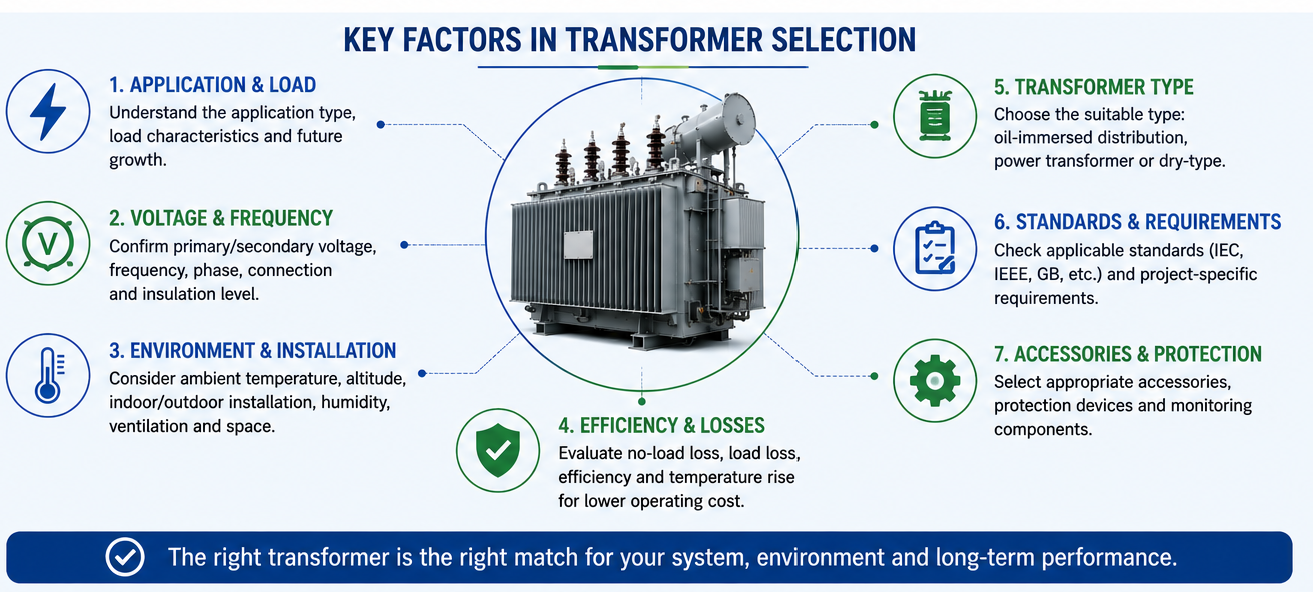
1. Start With the Application
The first question should not be:
“What size transformer do I need?”
It should be:
“What will the transformer be used for?”
A transformer supplying an industrial production line may have very different requirements from one used in a commercial building, solar power project, utility distribution network, or infrastructure project.
The application helps determine the appropriate transformer type, capacity, cooling method, insulation requirements, protection configuration, and other technical parameters.
Before selecting a transformer, it is useful to understand:
* What equipment will the transformer supply?
* Is the load continuous or intermittent?
* Are there large motors or other equipment with high starting currents?
* Is the transformer part of a utility network or an independent electrical system?
* Will the load increase in the future?
* Is the transformer installed indoors or outdoors?
The more clearly these requirements are defined, the more accurately the transformer can be designed.
2. Determine the Required Transformer Capacity
Rated capacity is one of the first specifications customers consider, but selecting the capacity requires more than looking at today’s maximum load.
The transformer should be able to handle the expected operating load without unnecessary thermal stress.
At the same time, selecting a transformer that is significantly larger than necessary may increase the initial investment and may not provide the best operating efficiency.
When determining transformer capacity, consider:
* Present electrical load
* Expected future load growth
* Load diversity
* Power factor
* Motor starting or other temporary high-current conditions
* Continuous versus short-term loading
* Required operating margin
For some projects, future expansion is an important consideration.
A transformer that is suitable for today’s load may become insufficient if the facility is expected to add production equipment or increase its electrical demand in the coming years.
The best capacity is therefore not necessarily the largest available capacity.
It is the capacity that is appropriate for the actual and expected operating conditions.
3. Confirm Primary and Secondary Voltage
The transformer’s voltage ratio must match the electrical system.
Before requesting a quotation, customers should clearly define the required:
* Primary voltage
* Secondary voltage
* Frequency
* Number of phases
* Voltage regulation requirements
* Connection configuration
* Vector group, where applicable
* Insulation level
Voltage requirements can vary considerably between countries, industries, and individual projects.
Providing complete voltage information at the beginning helps the manufacturer develop the correct winding configuration and insulation system.
It also reduces the risk of costly modifications later in the project.
4. Choose the Right Transformer Type
Not every application requires the same type of transformer.
Depending on the project, customers may consider solutions such as:
Oil-Immersed Distribution Transformers
These are widely used in power distribution systems and various industrial and infrastructure applications.
Their design can provide efficient heat dissipation and reliable long-term operation when properly specified and maintained.
Oil-Immersed Power Transformers
For higher-capacity applications, power transformers may require more advanced electrical, thermal, mechanical, and protection considerations.
The design is usually highly dependent on the specific project requirements.
Dry-Type Transformers
Dry-type transformers can be suitable for applications where installation conditions, fire-safety considerations, indoor installation, or other project requirements make an air-insulated solution appropriate.
The selection between oil-immersed and dry-type technology should therefore be based on the actual installation environment and technical requirements rather than simply on price.
5. Consider the Installation Environment
A transformer does not operate in a laboratory.
It operates somewhere in the real world.
Environmental conditions can have a significant influence on transformer design and operation.
Important factors may include:
* Ambient temperature
* Altitude
* Humidity
* Dust
* Pollution
* Corrosive environments
* Indoor or outdoor installation
* Ventilation
* Available installation space
* Noise requirements
For example, a transformer installed outdoors in a hot climate may have different thermal requirements from one operating inside a controlled industrial facility.
Similarly, projects located at high altitude may require additional design consideration because atmospheric conditions can affect cooling and insulation performance.
Providing the manufacturer with accurate environmental information is therefore an important part of transformer selection.
6. Pay Attention to Efficiency and Losses
Purchase price is only one part of the cost of a transformer.
A transformer may operate for thousands of hours every year, so its energy losses can have a meaningful impact on the total operating cost.
Customers should compare at least:
* No-load loss
* Load loss
* Efficiency
* Temperature rise
* Expected loading conditions
No-load losses occur when the transformer is energized, while load losses are related to current flowing through the windings and vary with the operating load.
For continuously energized transformers, no-load losses can be particularly important because they occur even when the transformer is carrying relatively little load.
This is why a transformer with a slightly higher initial purchase price can sometimes provide better long-term value if its operating losses are lower.
Do not compare transformers only by purchase price. Compare their total cost of ownership.
7. Consider Temperature Rise and Cooling
Electrical losses become heat.
The transformer therefore needs an appropriate thermal design to keep operating temperatures within the intended limits.
Temperature rise and cooling requirements depend on factors such as:
* Transformer capacity
* Loading conditions
* Ambient temperature
* Transformer type
* Installation environment
* Cooling method
For oil-immersed transformers, the tank, radiators, insulating liquid, and circulation of heat all contribute to thermal performance.
For dry-type transformers, the surrounding air and ventilation conditions are particularly important.
A transformer that is correctly matched to its thermal environment can operate more reliably and maintain the expected performance over its service life.
8. Check Applicable Standards and Specifications
Different projects may require different technical standards.
Depending on the customer’s location and application, specifications may refer to IEC, IEEE, GB, or other national and project-specific requirements.
The customer should confirm the applicable standards before the transformer is designed and manufactured.
This is particularly important for international projects because technical requirements can vary between markets.
A professional transformer manufacturer should be able to review the customer’s specification and identify the key requirements that need to be reflected in the design.
9. Don’t Forget Accessories and Protection
The transformer itself is only one part of the complete installation.
Depending on the transformer type and project requirements, additional equipment or accessories may include:
* Bushings
* Conservator
* Radiators
* Temperature indicators
* Pressure relief devices
* Buchholz relay
* Oil level indicators
* Tap changers
* Cooling fans
* Monitoring equipment
* Protection and control components
Not every project needs the same configuration.
The correct accessories should be selected according to the transformer design, installation environment, protection system, and customer’s technical specification.
Discussing these requirements with the manufacturer at the design stage helps ensure that the final transformer integrates properly with the customer’s electrical system.
10. Look at the Manufacturer, Not Just the Specification
Two transformers can have very similar specifications on paper and still differ significantly in manufacturing quality, process control, testing, and long-term reliability.
When evaluating a transformer manufacturer, customers should consider:
* Engineering capability
* Manufacturing experience
* Quality-control procedures
* Material sourcing
* Production equipment
* Testing capability
* Applicable certifications
* Previous project experience
* Technical support
* After-sales service
A transformer is a long-term investment.
The manufacturer you choose will influence not only the product you receive, but also the technical communication, customization process, testing, documentation, and support throughout the project.
A Practical Transformer Selection Checklist
Before requesting a transformer quotation, it is useful to prepare the following information:
Electrical Requirements
* Rated power
* Primary voltage
* Secondary voltage
* Frequency
* Phase
* Impedance
* Connection and vector group
* Insulation requirements
Operating Conditions
* Expected load
* Load profile
* Future load growth
* Ambient temperature
* Altitude
* Indoor or outdoor installation
* Environmental conditions
Project Requirements
* Applicable standards
* Efficiency requirements
* Temperature-rise requirements
* Noise requirements
* Protection requirements
* Accessories
* Testing requirements
* Delivery requirements
Providing this information allows the manufacturer to evaluate the project more accurately and recommend a suitable transformer configuration.
The Right Transformer Is the Right Match
There is no single transformer that is ideal for every application.
The right choice depends on how the transformer will be used, where it will operate, what electrical system it will connect to, and what performance is expected throughout its service life.
That is why we believe transformer selection should be an engineering discussion rather than simply a price comparison.
A good transformer selection balances:
Capacity + Electrical Performance + Efficiency + Thermal Performance + Reliability + Installation Conditions + Total Cost of Ownership
When these factors are considered together, customers can make a much more informed decision and avoid problems that may only become visible after installation.
Need Help Selecting a Transformer?
If you already have the basic electrical specifications for your project, our engineering team can review your requirements and recommend a suitable transformer solution.
Whether you need an oil-immersed distribution transformer, power transformer, dry-type transformer, or a customized solution, the first step is understanding your application.
Tell us your voltage, capacity, application, installation environment, and applicable standards—and we can help you identify the right transformer for your project.

 EN