When purchasing a transformer, it is easy to focus on the rated capacity, voltage, dimensions, delivery time, and initial purchase price.
However, there is another specification that deserves just as much attention: transformer efficiency.
A transformer may operate continuously for 20, 30 years, or even longer. During this time, even relatively small electrical losses can accumulate into a significant amount of wasted energy and operating cost.
For this reason, transformer efficiency should not be viewed simply as a technical parameter. It is an important part of the total cost of owning and operating a transformer.
What Does Transformer Efficiency Really Mean?
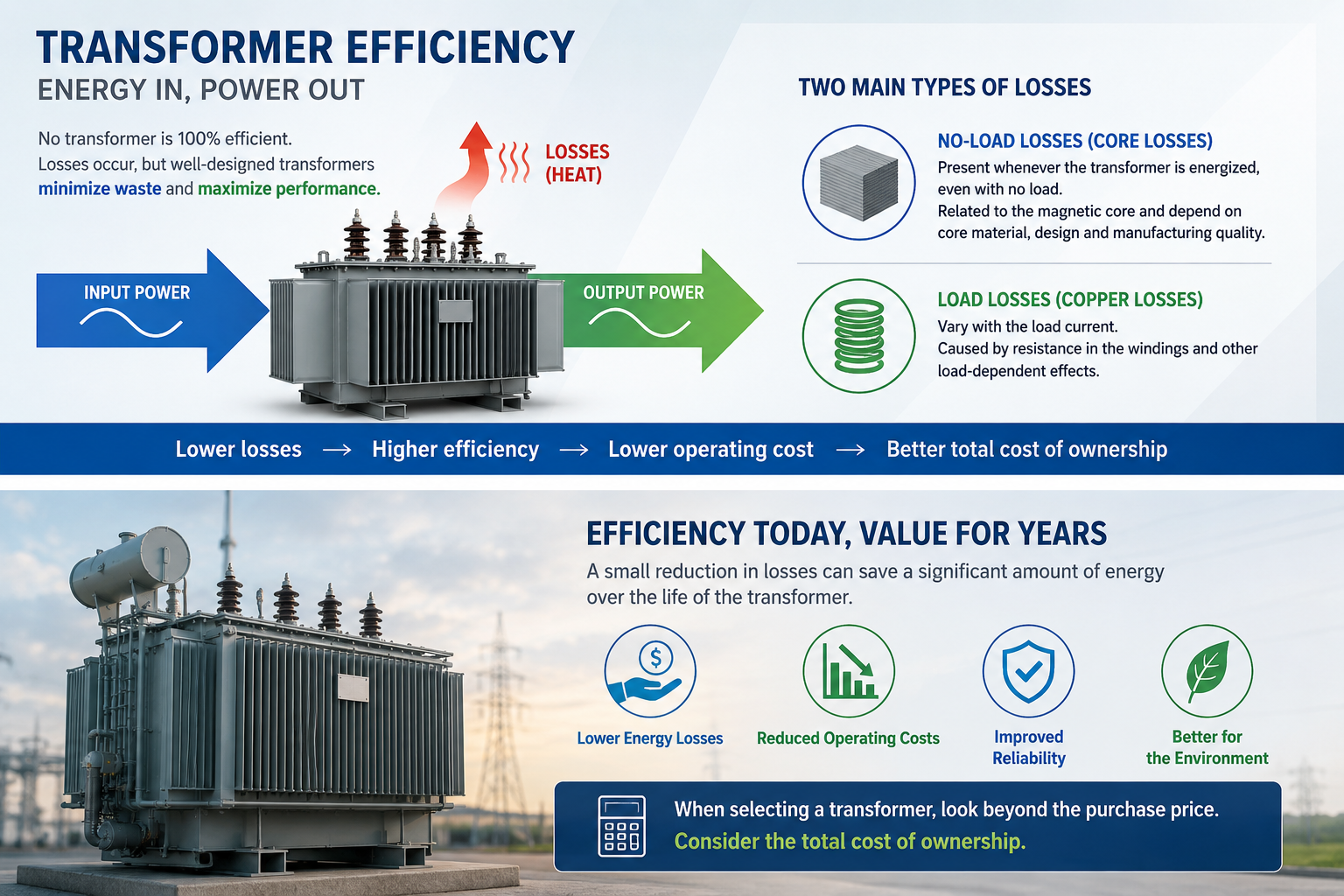
In simple terms, transformer efficiency describes how effectively a transformer transfers electrical power from its input side to its output side.
No transformer can transfer 100% of the input energy to the load. A portion of the energy is inevitably converted into heat and other losses during operation.
For transformer design and evaluation, these losses are commonly considered in two main categories:
* No-load losses
* Load losses
Understanding the difference between them is essential when selecting a transformer for a real application.
No-Load Losses: Energy Consumed Even When the Load Is Low
No-load losses are mainly associated with the transformer’s magnetic core.
One important characteristic is that these losses occur whenever the transformer is energized, even when the secondary side is supplying little or no load.
This makes no-load loss particularly important for transformers that remain connected to the power system continuously.
For example, a distribution transformer serving a commercial building may remain energized throughout the year. The building’s electricity demand may change considerably during the day, but the transformer itself remains in service.
Therefore, reducing no-load losses can provide benefits throughout the entire operating period—not only when the transformer is heavily loaded.
Core material, magnetic flux density, core construction, joint design, and manufacturing precision can all influence the resulting no-load performance.
This is one reason why transformer efficiency begins with engineering and material selection long before the transformer reaches the testing stage.
Load Losses: Efficiency Changes With Transformer Loading
Load losses behave differently.
They are mainly related to current flowing through the transformer windings and increase as the transformer carries more load. In practical terms, the amount of load loss depends strongly on the transformer’s operating point.
This means that two transformers with the same rated capacity can have different energy performance under the same operating conditions.
It also means that looking at efficiency at only one operating point does not always tell the complete story.
A transformer used in an industrial plant, for example, may experience a very different load profile from a transformer used in a commercial building or a renewable energy installation.
When selecting a transformer, the expected operating pattern should therefore be considered together with the nameplate rating.
Why Lower Losses Can Matter More Than a Lower Purchase Price
Transformer purchasing decisions are sometimes made primarily on the initial equipment price.
But the initial quotation represents only one part of the total cost.
A transformer also creates operating costs over its service life through energy losses, maintenance, cooling requirements, and other associated expenses.
Consider a transformer that operates continuously. If its losses can be reduced by even a relatively small amount, that difference is repeated over thousands of operating hours.
Over several years, the accumulated energy savings may become much more significant than the original difference in purchase price.
This is why experienced transformer buyers often look beyond the purchase price and compare total cost of ownership.
The better question is not simply:
“Which transformer is cheaper to buy?”
It is:
“Which transformer provides the best balance between purchase cost, energy losses, reliability, and long-term operating cost?”
Efficiency Is a Design Decision
High transformer efficiency does not come from one individual component.
It is the result of many engineering decisions working together.
For example, transformer designers may need to consider:
* Core material and magnetic flux density
* Core construction and joint quality
* Conductor material and cross-sectional area
* Winding design
* Current density
* Impedance requirements
* Cooling conditions
* Temperature rise
* Manufacturing tolerances
* Expected loading profile
Improving one performance parameter can sometimes influence another.
For this reason, transformer engineering is fundamentally a process of finding the right balance between electrical performance, thermal performance, mechanical strength, manufacturing feasibility, reliability, and cost.
A professional manufacturer should therefore look at efficiency as part of the complete transformer design rather than treating it as an isolated number on a test report.
Efficiency Must Be Verified, Not Just Promised
A transformer specification is meaningful only when the actual product can meet the specified requirements.
This is why testing is an essential part of transformer manufacturing.
No-load losses and load losses can be measured during transformer testing, allowing the manufacturer’s design and manufacturing results to be evaluated against the required specifications.
IEC TS 60076-20 provides approaches for defining and evaluating the energy efficiency of power transformers, while IEC 60076-1 establishes general requirements for power transformers and includes requirements related to testing. (IEC Webstore)
For manufacturers, accurate loss measurement is therefore not simply a final quality-control activity. It also provides valuable feedback about the effectiveness of the overall design and manufacturing process.
Efficiency and Reliability Should Be Considered Together
Energy efficiency is important, but it should never be considered independently from reliability.
A transformer operates as a complete electrical and thermal system.
Core losses, winding losses, temperature rise, insulation performance, cooling, and loading conditions are interconnected. A good transformer design needs to maintain stable performance under its intended operating conditions.
This is particularly important for industrial facilities, utility networks, renewable energy projects, data centers, and other applications where transformer downtime can have a much greater cost than the equipment itself.
For these applications, the goal should not simply be to achieve a lower loss figure.
The goal is to achieve efficient, stable, and reliable operation over the entire service life of the transformer.
How We Look at Transformer Efficiency
As a transformer manufacturer, we believe that efficiency should be considered from the beginning of the engineering process.
It starts with understanding the customer’s actual application.
What is the expected load?
How many hours will the transformer operate each year?
Will the load remain relatively constant, or will it fluctuate significantly?
What are the ambient conditions?
What efficiency requirements and technical standards apply to the project?
These questions help determine what kind of transformer design is appropriate.
The best transformer is not necessarily the one with the highest rating or the lowest initial price. It is the transformer whose design is properly matched to the customer’s electrical system and long-term operating requirements.
A Better Way to Evaluate a Transformer
When comparing transformer quotations, we recommend looking beyond the basic purchase price.
A meaningful comparison should include:
Rated capacity → No-load loss → Load loss → Efficiency → Temperature rise → Operating conditions → Expected service life → Total cost of ownership
This approach allows buyers to compare transformers based on their actual long-term value rather than simply comparing the numbers on the first page of a quotation.
A transformer is a long-term investment in an electrical system.
Choosing an efficient transformer today can help reduce energy waste, control operating costs, and support reliable power delivery for years to come.
Good transformer efficiency is not just about saving energy. It is about making better engineering decisions from the very beginning.

 EN